This year’s HSJ Patient Safety Congress brought together leaders, clinicians, and quality improvers from across the country to share insights, celebrate progress and shape the future of safety across the NHS. The Health Innovation East patient safety team was proud to attend and reflect on the key themes emerging from the event – from leadership and culture to data-driven improvement and patient empowerment.
Setting the scene: the state of safety in the NHS
The conference opened with a powerful address from Dr Penny Dash, Chair of NHS England, who reflected on the evolution of the NHS’s approach to safety and what’s next for the system. On review of her recently published report (1), it would appear that the NHS has shifted towards safety rather than embracing the Triple Aim of Quality Care – improving patient experience, enhancing population health and reducing the per capita cost of care (2).
It can feel risky to move beyond the principle of “Do No Harm” which is the most fundamental principle of any healthcare service (3). However, we should also recognise that true safety includes a focus on quality, and this should also be embraced for lasting safety improvements. True safety cannot exist in isolation; we need care that meets all three elements of the Triple Aim. By improving efficiency and reducing cost, we create the capacity to invest in prevention and population health – ultimately delivering safer, higher-quality care for patients and staff alike.
What is the Triple Aim of Quality Care?
The Triple Aim of Quality Care is a framework for healthcare improvement that seeks to simultaneously improve patient experience, improve population health, and reduce per capita cost. Safety forms the essential foundation across all three of these areas.
Strategic Direction: a shared vision for safer care
Dr Aidan Fowler, National Director of Patient Safety at NHS England presented the impact of the NHS Patient Safety Strategy (picture 1), showcasing several national programmes – including many delivered in partnership with the Health Innovation Network’s Patient Safety teams.
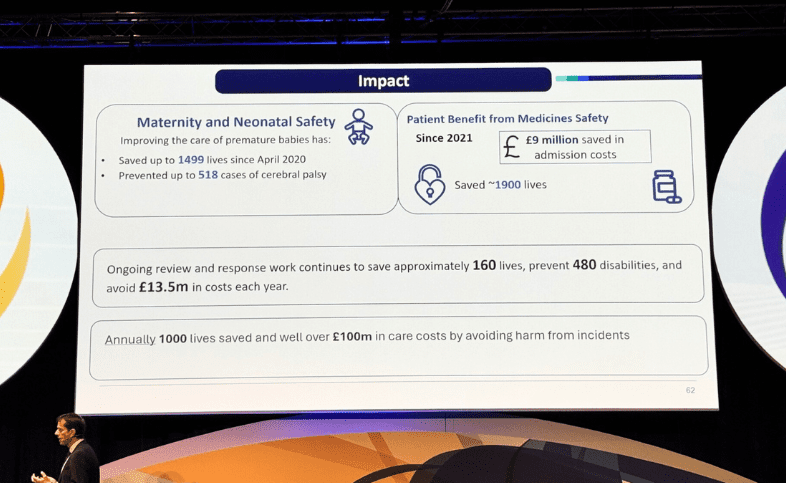
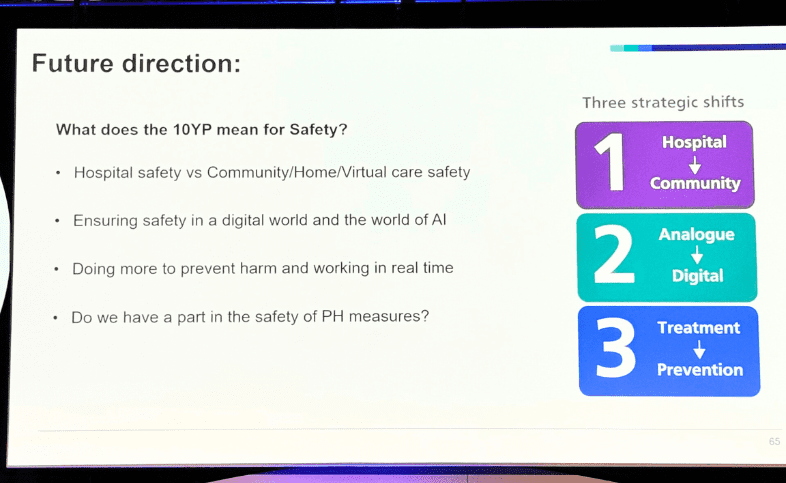
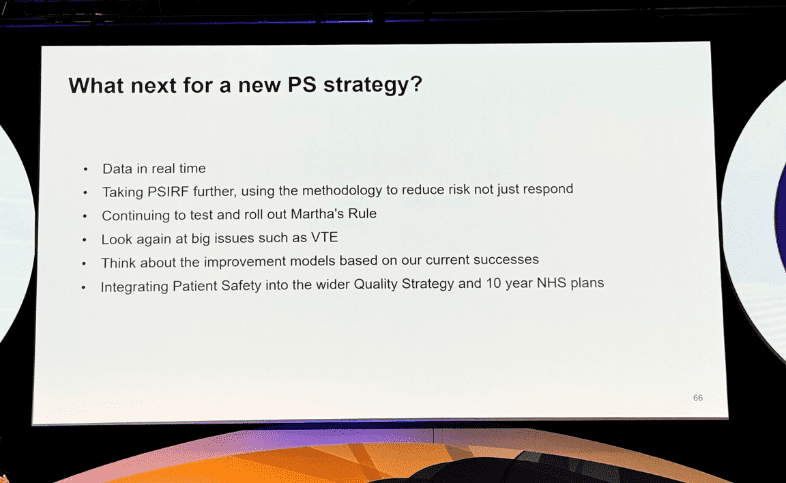
Looking ahead, he shared his thoughts on a key question, “What does the 10 Year Health Plan mean for safety” (picture 2) and he outlined the refreshed direction of a new patient safety strategy (picture 3). It was encouraging to see the strong alignment between our programmes and these emerging priorities. The impact of our work is already evident – for example, between April 2020 to June 2025, through our work on the maternity and neonatal optimisation pathway, 898 women giving birth at less than 30 weeks of gestation received magnesium sulphate within 24 hours prior to birth. With this intervention it is estimated that 24 babies will not develop cerebral palsy, resulting in a potential cost saving to welfare and society of between £19.2 million and £24 million. The clear alignment between our programmes and the national patient safety priorities reaffirms the Health Innovation Network’s roles – and that of our patient safety team – as NHS England’s key delivery partners for patient safety in the East of England.
Key themes from Congress
Using data to inform programme development
A standout session at the Patient Safety Congress highlighted the power of data and interoperability in driving safety and quality improvements. Simple, co-produced, user-friendly digital systems are crucial for real-time reporting and generating predictive insights. While NHS-wide transformation takes time, staff knowledgeable in measurement for improvement methodology can play a key role in helping teams to interpret data effectively, identify gaps and drive quality improvement at every level.
We have seen this in action through our work on the ‘optimisation and stabilisation of the preterm infant’ workstream which demonstrates how evidence-based care can directly improve outcomes for mothers and babies. We share key data captured by trusts which is then analysed and presented on the Maternity Neonatal dashboard. By utilising measurement for improvement principles, clinical expertise and national intelligence, we can highlight specific interventions or trusts demonstrating significant progress, as well as those requiring targeted support.
This approach not only celebrates and spreads best practice but also simultaneously identifies and flags areas where timely quality improvement is essential to meet national ambitions and targets.
Recognising and managing deterioration: Martha’s Rule
With Martha’s Rule first introduced into the NHS in Spring 2024, we have been working closely with our local NHS acute sites to implement this safety programme into their trusts. Established to empower patients, families, care givers and staff to raise concerns about patients’ clinical deterioration when the usual pathways of escalation have not worked, Martha’s Rule provides a mechanism to ensure that those concerns are heard and that an independent review can identify subtle signs of deterioration early.
A session at the Patient Safety Congress highlighted the challenges encountered, and future priorities for embedding it into clinical practice. National data shows that Martha’s Rule is achieving its purpose, successfully identifying patients with early signs of deterioration. Approximately 40% of all Martha’s Rule calls relate to true clinical deterioration – clear evidence that the programme is having its intended impact.
Since its launch, over 5,000 calls to escalate concerns have been made, demonstrating the importance of truly listening to our patients, caregivers, families, and staff. This is not simply a skill to be learned, but a mindset to be fostered – one that encourages open communication and a shift in clinical culture so that expressions of concern can be voiced confidently and effectively.
Importantly, Martha’s Rule is not a means of seeking a second opinion. Rather, it represents a fundamental cultural transformation within healthcare – one that promotes open conversations, encourages the early identification of deterioration before clinical signs worsen, and provides reassurance and guidance when the usual routes of escalation have broken down.
With Martha’s Rule now being implemented at every acute hospital in England as of September 2025, the session also celebrated the hard work of NHS sites in testing and implementing the programme. This includes the strong collaboration between adult and paediatric services, as well as specialist areas, to ensure the approach is robust and adaptable across acute care settings.
Looking ahead, the continued progress of the Martha’s Rule programme will focus on several key areas. The 143 Phase 1 sites will continue to share their learning both locally and nationally, informing the ongoing development of the programme. Phase 2 sites have begun testing and implementing the three components of Martha’s Rule, sharing insights to support continuous improvement. In addition, national learning will be drawn from testing the programme in specialist settings such as emergency departments, maternity services, community care, and inpatient mental health units.
Empowering change: improving medicines safety for people with learning disabilities
The Medicines Safety Improvement Programme continues to focus on tackling the most significant causes of harm linked to medicines. For 2025-26, the priority is on improving care for people with learning disabilities – particularly by reducing the burden of medicines that act on the brain.
Within the NHS, many individuals still face barriers to being heard, understood, and supported in their healthcare journeys. To truly make progress, we need a cultural transformation – one that empowers patients, supports self-advocacy, and places people with lived experience at the heart of change.
At this year’s Patient Safety Congress, a thought-provoking session explored how we can create more equitable and accessible care for people with learning disabilities. The discussion brought to light both the ongoing challenges and the potential enablers for real change.
People with learning disabilities often have complex health needs. They may need extra time to express what they’re experiencing, and they may require access to advocates who can help them navigate the healthcare system. Unfortunately, current systems of care are not always cohesive, leaving many feeling unheard or misunderstood.
The LeDeR 2023–2024 report provides sobering insight into why people with learning disabilities and autism still die, on average, more than 20 years earlier than those without such disabilities.
Another key issue is diagnostic overshadowing – when healthcare professionals attribute new symptoms or behavioural changes to a person’s learning disability rather than recognising potential underlying illness. This misunderstanding can delay or prevent appropriate treatment, with devastating consequences.
Encouragingly, the session also highlighted practical ways forward. Education and awareness are vital – healthcare professionals need training that helps them better understand and respond to the needs of people with learning disabilities. By tuning into a patient’s frequency, clinicians can tailor their care to the individual, rather than relying on assumptions.
System-wide change is also essential. The NHS must continue to create opportunities for co-production, engaging directly with people who have learning disabilities and their caregivers. Shifting the power of decision-making from clinicians to patients and families will help ensure care is truly person-centred and inclusive.
Ultimately, the national Medicines Safety Improvement Programme aims to empower patients through a more holistic model of support. By reducing reliance on medication and expanding access to non-medical interventions and advocacy, the programme seeks to enable people with learning disabilities to make informed choices about their health – with confidence and autonomy.
Looking ahead
The 2025 Patient Safety Congress reaffirmed a powerful truth: safety is everyone’s responsibility. Whether through culture change, leadership development, or the use of data and insight, progress depends on collaboration across every part of the system.
At Health Innovation East, we remain committed to working alongside our NHS partners to embed learning, drive improvement, and make healthcare safer for patients, families, and staff alike.
Find out how we work to embed national patient safety improvement programmes
Find out how we play a critical role in identifying and spreading safer care initiatives across our region here
References
References
(1) https://assets.publishing.service.gov.uk/media/686bd5d52cfe301b5fb6780c/dhsc-review-of_patient-safety-across-the-health-and-care-landscape.pdf
(2) https://www.ihi.org/library/publications/triple-aim-care-health-and-cost
(3) https://www.who.int/news-room/fact-sheets/detail/patient-safety
You might also like…

For World Patient Safety Day, Health Innovation East shares we are leading the delivery of a national Maternity Neonatal (MatNeo) programme to ensure “Safe care for every newborn and every child”.

East of England Ethnic Minority Nurses, Allied Health Professionals and Social Care Leadership Development Programme

Optimisation and stabilisation of the preterm infant
Share your idea
Do you have a great idea that could deliver meaningful change in the real world?
Get involved