Insight – transforming wound care
Integrated Care Systems have begun to transform the way the NHS treats leg ulcers.
“A joined up, national approach to wound care is urgently needed to prevent the [challenges presented] and prevent them from remaining hidden. That there are few nationally mandated metrics or reporting requirements related to wound outcomes, must change”. (1)
“A joined up, national approach to wound care is urgently needed to prevent the [challenges presented] and prevent them from remaining hidden. That there are few nationally mandated metrics or reporting requirements related to wound outcomes, must change”. (1)
During 2025/26, under Health Innovation East’s leadership, four Health Innovation Networks (HINs) introduced pathway changes, embarked on system transformation programmes and established a strong economic case for embedding new ways of working.
Done optimally, wound care represents a major opportunity to reduce strain on NHS budgets. Transforming the way wounds are cared for means not only improving the quality of life of the 3.8 million people living with wounds (2) but also mitigating the economic effect of unhealed wounds (3).
Caring for wounds is a complex, under-addressed issue in the NHS. Wound care is the NHS’s third highest expense, after cancer and diabetes. Yet, the scale of its impact is rarely reflected in national priorities and frameworks (1).
Wound care statistics – all wounds
• Wounds left untreated cost the NHS £5.8 billion annually.
• Caring for wounds account for 50% or more of all community nursing time, equating to 54.5 million visits annually.
• 2.4 million people in the UK live with a non-healing wound at any given time.
For patients living with a wound both physical and psychological strain can be a factor. Pain, impaired mobility, low mood and sleep disturbance can affect everyday life.
Lower limb wounds, particularly leg ulcers, often take longer to heal and disproportionately contribute to the need for specialist care. Leg ulcers account for around 40% of wounds, the largest percentage of all wounds (2).
Intervention – from strategy to implementation
Beginning in October 2022 and completing in March 2026 Health Innovation East led the Transforming Wound Care programme (TWC), which was designed to improve care for patients with lower limb wounds. To achieve its goal the programme focused on implementing the Leg Ulcer Best Practice Bundle (LUBPB), a pathway stemming from the National Wound Care Strategy programme, across several NHS test sites
Data from the sites showed the LUBPB achieving significant improvements in healing rates, accompanied by extremely high patient experience scores and strong support for adoption among staff.
Intervention – sustaining excellence
Following TWC’s initial success, decision makers in Integrated Care Boards (ICB) were encouraged to ‘redesign integrated and sustainable models of [wound] care delivery’ (1). However, it became apparent that support available to implement a redesign was limited.
Consequently, to further the spread of the evidence-backed lower limb wound care pathway, Health Innovation East led a cluster of four health innovation networks and their expert teams to provide tailored implementation support.
Across 12-months, Health Innovation East, Health Innovation East Midlands, Health Innovation West of England and Health Innovation Oxford and Thames Valley, covering nine ICBs and 22 NHS providers, delivered workshops, webinars, data collection and synthesis, communities of practice and other bespoke regional support.
Intervention – a £108 million case for investment
Alongside its work in the cluster, Health Innovation East commissioned an independent report from Frontier Economics on the ‘Economic impact of leg ulcers in the UK’*. The findings of which, applied nationally, support the case for transforming how we care for wounds (3). The analysis focusses only on leg ulcers, in the UK.
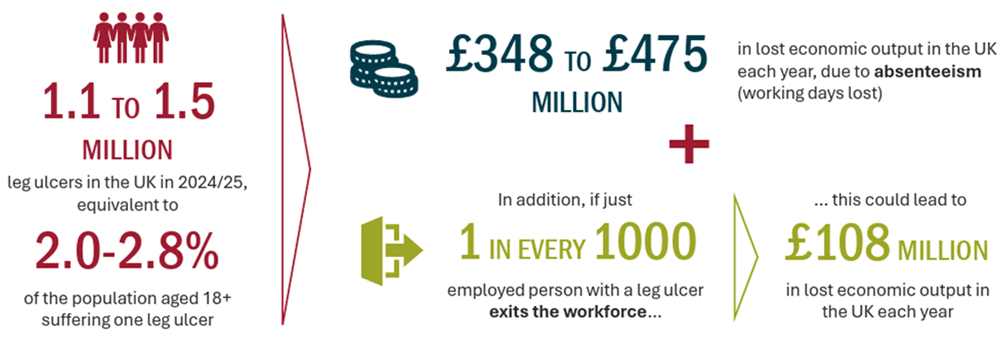
Further, additional savings are available within the NHS, from reduced demand for care e.g. demand on community nursing (op cit.), making the overall benefit of taking action even greater. The framework and economic modelling from which these findings are derived can be found in the report, which is available on the Health Innovation Network website.
* This rapid review, undertaken between July and October 2025, focuses on reviewing the existing literature, evidence and economic thinking. Further work could include new primary research into the impact of leg ulcers on individuals and their ability to work.
Impact – helping systems and pathways transform
While the evaluations of previous innovative efforts show faster healing, fewer recurrences and lower NHS costs, the adoption of evidence based approaches varies between NHS providers. Understandably, change is sometimes difficult, but it is certainly possible as the examples below help illustrate.
Health Innovation East: preventing ‘forever patients’
During 2025, East Coast Community Health Care CIC (ECCH) studied 63 adults under 60 years old with leg ulcers. Participants were from a geography with high smoking and high-risk drinking rates, and where levels of obesity or being overweight were 19% above national average – each factor linked to increased risk of lower limb wounds. Improving integration between weight management and smoking cessation services was identified as essential to supporting treatment pathways. Health Innovation East led a project involving patient interviews, a stakeholder workshop and promotion of the LUBPB. The work provided community nursing teams with a stronger evidence base and improved clinicians’ understanding of patients’ experiences. It also strengthened links between health and wellbeing services to support active lifestyles.
“I’ve had about two dozen severe motorcycle accidents, but I would rather have a motorcycle accident every day for a month, than struggle with the discomfort and pain that I’m in with leg ulcers.” [Derek, Leg Ulcer Clinic patient]
Health Innovation West of England: enabling clear system plans
Bristol, North Somerset and South Gloucestershire ICS and Health Innovation West of England convened a workshop of 20 multidisciplinary stakeholders. Participants assessed the current landscape, defined future ambitions and prioritised actions. The system priorities established as a result included aligning governance structures and reporting mechanisms and developing consistent care plans. Stronger collaboration and clear action plans at the ICB resulted.
“It is clear that there are well-defined objectives and actions in place to help the ICB and stakeholders move this programme forwards”
Health Innovation Oxford and Thames Valley
Through a series of transformation efforts and workshops, the team embedded best practice at primary care clinics in Yateley, Surrey Heath and Frimley Health NHS Foundation Trust; implemented an inpatient compression therapy model at Oxford University Hospital; supported a District Nurse-led lower limb wound clinic serving house-bound patients and established a tissue viability and lymphoedema (a long-term condition that causes swelling the body’s tissues) network (5).
Health Innovation East Midlands
The team worked with the Nottingham and Nottinghamshire ICB in pursuit of the goal of system wide wound care transformation. All 6 of the ICB’s providers were involved in an in-person leg ulcer pathway mapping session, providing understanding of pathways and future plans to standardise care. Two providers engaged in developing templates to aid data collection, which has always been a difficulty in wound care, but furthers understanding of caseload size and the areas where intervention is most needed.
In conclusion
Robust economic analysis, built on a solid foundation of academic research and evidence gleaned from health innovation network led transformation programmes, supports the case for prioritising change in how we care for wounds.
Collectively these insights can be used to inform NHS decision making. Health Innovation East’s leadership has resulted in pathways improved and initiatives implemented, which is to be celebrated. However, wide sustained change in leg ulcer care will only be achieved with a highly collaborative national effort from health and care providers, commissioners and policy makers. Health Innovation East and the partners in this work stand ready in support.
References
References
(1) Wood, K. et al. (2026). Invisible patients, unsustainable practice: insights from 20 000 wounds to drive solutions across integrated care system. British Journal of Healthcare Management. 32(2), pp.1-24. [Online]. Available at: https://www.magonlinelibrary.com/doi/full/10.12968/bjhc.2026.0005 [Accessed 20 April 2026].
(2) Guest, J. Fuller, G. Vowden, P. (2020). Cohort study evaluating the burden of wounds to the UK’s National Health Service in 2017/2018: update from 2012/2013. BMJ Open. 10(1136). [Online]. Available at: 10.1136/ bmjopen-2020-045253 [Accessed 20 April 2026].
(3) Health Innovation Network. (2026). Economic Impact of Leg Ulcers in the UK. [Online]. thehealthinnovationnetwork.co.uk. Last Updated: 15 April 2026. Available at: https://thehealthinnovationnetwork.co.uk/news/new-report-economic-impact-of-leg-ulcers-in-the-uk/ [Accessed 20 April 2026].
(4) Health Innovation Oxford and Thames Valley. (2025). Transforming wound care programme. [Online]. healthinnovationoxford.org. Last Updated: 2025. Available at: https://www.healthinnovationoxford.org/our-work/patient-safety/transforming-wound-care-programme/ [Accessed 20 April 2026]
(5) (2026). Overview: Lymphoedema. [Online]. www.nhs.uk. Available at: https://www.nhs.uk/conditions/lymphoedema/ [Accessed 21 April 2026].